The Complete Guide to Social Media Strategies for Small Business (2026 Edition)
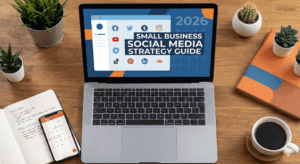
Running a small business in 2026 means wearing a lot of hats: CEO, accountant, customer service rep, and—whether you like it or not—marketing director. When you stare at a blank screen wondering what to post, managing social media for small business can feel like a second full-time job.
But here is the truth: You don’t need to be viral on every platform to see results. You just need a plan.
This guide will walk you through actionable social media strategies for small business that drive real growth, not just vanity metrics. Whether you are a local contractor, a boutique owner, or a service provider, this is how you turn “posting randomly” into a revenue-generating machine.
Why You Need a Documented Strategy (Not Just a Calendar)
Many owners confuse a “calendar” with a “strategy.” A calendar tells you when you are posting; a strategy tells you why.
Social media and small business growth go hand-in-hand, but only if your content serves a business goal. Without a strategy, you are just making noise. A documented strategy answers three critical questions:
- Who are we talking to?
- What do we want them to do? (Buy, sign up, call?)
- How will we measure if it worked?
By answering these, you move from “guessing” to managing small business social media with intent.
Step 1: Audit and Select Your Platforms
One of the biggest mistakes is trying to be everywhere. How small business use social media effectively involves selection, not saturation.
- B2B & Professional Services: LinkedIn is your powerhouse.
- Visual Brands (Restaurants, Retail, Real Estate): Instagram and Pinterest are non-negotiable.
- Local Services (Plumbers, HVAC): Facebook and Google Business Profile remain king for local trust.
- Gen Z Target: TikTok is where the attention is.
💡 Pro Tip
If you are in a specialized industry like Real Estate or Hospitality, your platform choice is critical.
Read our specific guide on Social Media for Real Estate Agents here
Step 2: Define Your Content Pillars
Stop waking up and asking, “What should I post today?” Instead, use Content Pillars—3 to 5 core topics that represent your brand. This is one of the most effective social media for small business tips to save time.
The “Rule of Thirds” for Content
When developing social media campaign ideas for small business, aim for this balance:
- 1/3 Promotion: Sell your services, show your products, and ask for the sale.
- 1/3 Education: Teach your audience something. If you are a plumber, show how to unclog a sink. If you are a realtor, explain mortgage rates.
- 1/3 Brand/Personality: Behind-the-scenes, team photos, and community involvement. People buy from people.
Step 3: Master the Workflow (How to Manage It All)
The hardest part of managing social media for small business is consistency. The solution is Batching.
Do not write posts every day. Instead, set aside two hours on a Monday to write all your captions and design your graphics for the entire week (or month).
Using the Right Tools
You cannot build a house without a hammer, and you cannot manage social effectively without software. You need a scheduler to auto-publish your content so you can get back to running your business.
See our comparison of the Best Social Media Management Tools for Small Business here
Step 4: Engagement is the “Social” in Social Media
Many businesses treat social media like a billboard—they post and leave. This is a mistake. How to use social media for small business correctly means being social.
- Reply to every comment: Even a simple “Thank you!” signals to the algorithm that your post is valuable.
- DM Management: For many customers, DMs are the new email. Answering inquiries quickly can be the difference between a sale and a lost lead.
Step 5: Measuring Success (Beyond Likes)
How do you know if it’s working? You need to look at the right data.
- Awareness: Reach and Impressions (Are people seeing you?)
- Engagement: Comments and Shares (Do people care?)
- Conversion: Clicks to your website or “Link in Bio” taps (Are they buying?)
If you are spending hours on content but seeing zero conversions, it’s time to revisit the strategy.
Conclusion: Start Small, Scale Later
Building authority takes time. Do not let the pressure of manage small business social media workflows paralyze you. Start with one platform, master it, and then expand.
The goal of social media strategies for small business isn’t to be famous—it’s to be profitable.
Need Help Executing This Strategy?
We know that as a business owner, you might not have the time to film Reels or analyze hashtags. That’s where we come in.
Check out our social media packages for small business to see how we can take the daily grind off your plate so you can focus on what you do best.